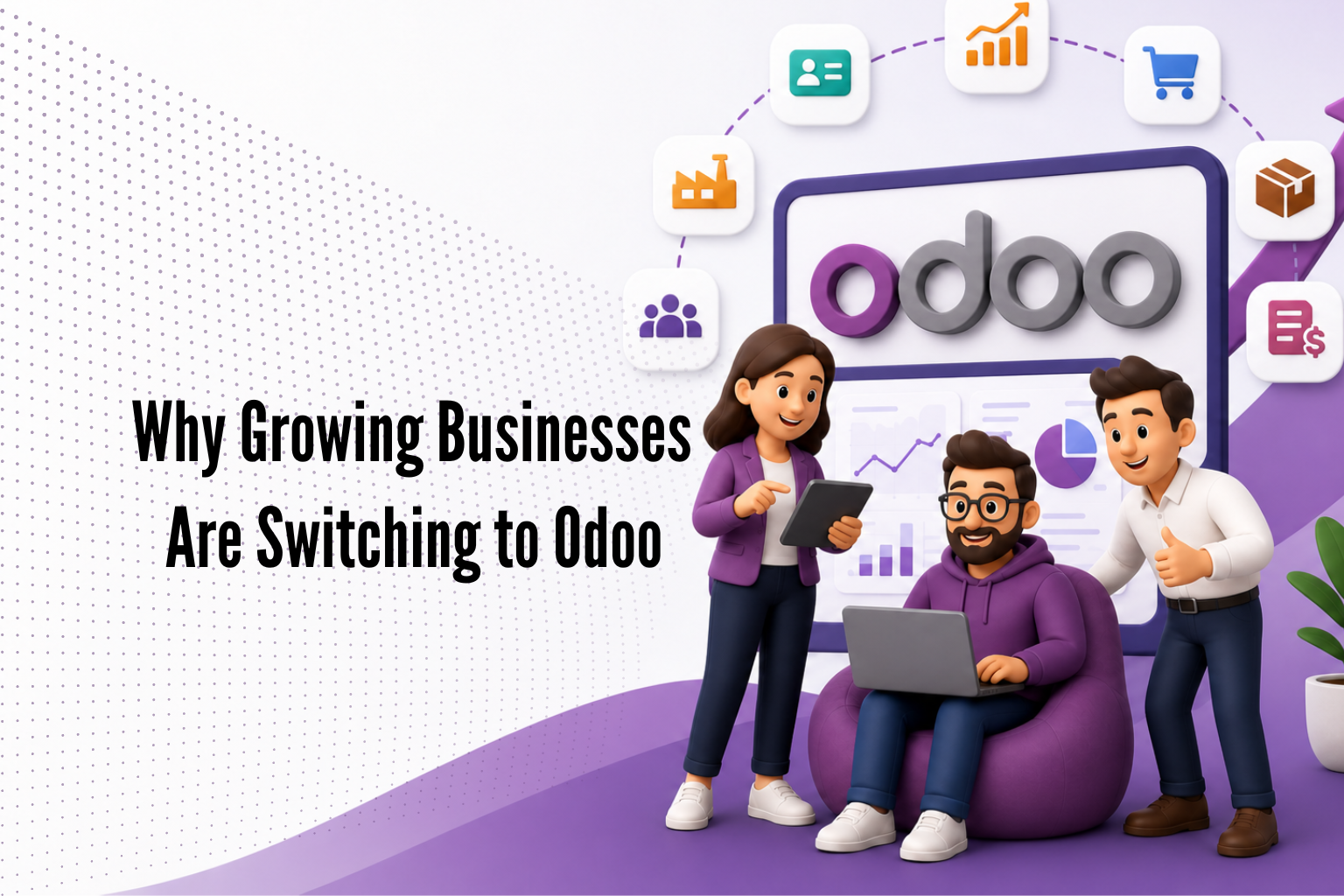
Why Growing Businesses Are Switching to Odoo — And Why You Should Too
Running a business means juggling a dozen moving parts at once — sales pipelines, inventory levels, invoices, payroll, customer support, and more. Most companies end up stitching together a patchwork of disconnected tools: one app for accounting, another for CRM, a spreadsheet for inventory, and an email thread for everything that doesn’t fit. It works — until it doesn’t.
That’s exactly where Odoo changes the game.
What Is Odoo?
Odoo is a business management platform that handles all your company functions.It covers sales, CRM, accounting, inventory, HR, manufacturing, e-commerce and project management with a set of modules.Odoo is easy to use. Does not require a big IT team. You only pay for the Odoo modules you need. Can add more as your business grows. Odoo has, over 12 million users worldwide. A strong open-source community. Many small and mid-sized businesses trust Odoo and large enterprises are also using it. The Odoo platform is flexible. Can grow with your business. You do not pay for Odoo features you will not use. Odoo helps you manage your business with one platform.
The Real Cost of Disconnected Tools
Before understanding why Odoo is valuable, it helps to understand what it’s replacing.
A typical growing business might be using QuickBooks for accounting, Salesforce for CRM, a separate HR tool for payroll, and maybe a warehouse management system that talks to none of the above. Every time a sale closes, someone has to manually update the inventory. Every time payroll runs, data has to be exported and re-imported. Every report requires pulling numbers from three different places and hoping they match.
This isn’t just inefficient — it’s expensive. Studies consistently show that data silos and manual re-entry are among the top contributors to operational errors and wasted employee hours. Multiply that across a team of 50 or 500 people, and the hidden costs become significant.
Odoo eliminates those silos entirely. When a sales order is confirmed, inventory updates automatically. When an invoice is paid, accounting entries are posted without anyone lifting a finger. Every department sees a single, consistent version of the truth.
Key Odoo Modules That Drive Business Value
Sales & CRM: Manage your entire pipeline from lead to close. Track customer interactions, automate follow-ups, generate quotes, and convert opportunities into sales orders — all from one interface.
Accounting & Finance: Odoo’s accounting module is full-featured and fully integrated. Bank reconciliation, tax reporting, invoicing, expense management — it’s all there, and it syncs automatically with sales and purchasing.
Inventory & Warehouse Management: Real-time stock tracking, multi-warehouse support, automated reordering rules, and full traceability across your supply chain. Whether you’re running a retail operation or a complex distribution network, Odoo scales with you.
Manufacturing (MRP): Plan production runs, manage bills of materials, track work orders, and maintain quality control. Odoo MRP connects directly to your inventory and sales, so there are no surprises on either end.
Human Resources: From recruitment and onboarding to leave management, payroll, and performance reviews — Odoo HR keeps your people operations running smoothly.
E-Commerce & Point of Sale: Sell online or in-store with Odoo’s native e-commerce and POS modules. Both sync in real-time with inventory and accounting, so your numbers are always accurate.
Why Implementation Matters as Much as the Software
Odoo’s power is real — but it’s only unlocked when it’s configured properly for your specific business. The most common reason companies underutilize their ERP investment isn’t the software itself; it’s the implementation.
Out-of-the-box Odoo is flexible, but “flexible” also means there are hundreds of decisions to make: which modules to activate, how to map your existing processes, how to migrate historical data, how to train your team, and how to customize workflows to fit your industry.
This is why working with an experienced Odoo partner isn’t optional — it’s the difference between a system that transforms how you operate and one that collects digital dust.
A good Odoo implementation partner will:
- Conduct a thorough analysis of your current workflows before touching a single setting
- Design a rollout plan that minimizes disruption to your day-to-day operations
- Handle data migration from your existing systems carefully and accurately
- Customize modules where your business has unique requirements
- Train your team so they actually use the system effectively
- Provide ongoing support as your needs evolve
Getting this right from the start saves enormous time, money, and frustration down the line.
Is Odoo Right for Your Business?
Odoo works well across a wide range of industries — retail, manufacturing, distribution, professional services, non-profits, and more. It’s particularly well-suited for businesses that have outgrown entry-level tools like QuickBooks or basic CRMs but aren’t ready (or willing) to invest in the six-figure price tag of legacy enterprise systems like SAP or Oracle.
If your team is spending too much time on manual data entry, if you’re making decisions based on stale or inconsistent information, or if your current tools simply don’t talk to each other, Odoo is worth a serious look.
Ready to Explore Odoo for Your Business?
Odoo has the potential to genuinely change how your business operates — but the path from potential to results starts with the right partner.
Strats360 specializes in end-to-end Odoo implementation, customization, and support. Whether you’re migrating from an existing ERP, starting fresh, or looking to extend an existing Odoo setup, their team brings the expertise to make it work for your specific business needs.
Visit strats360.com/odoo to learn more and get started.